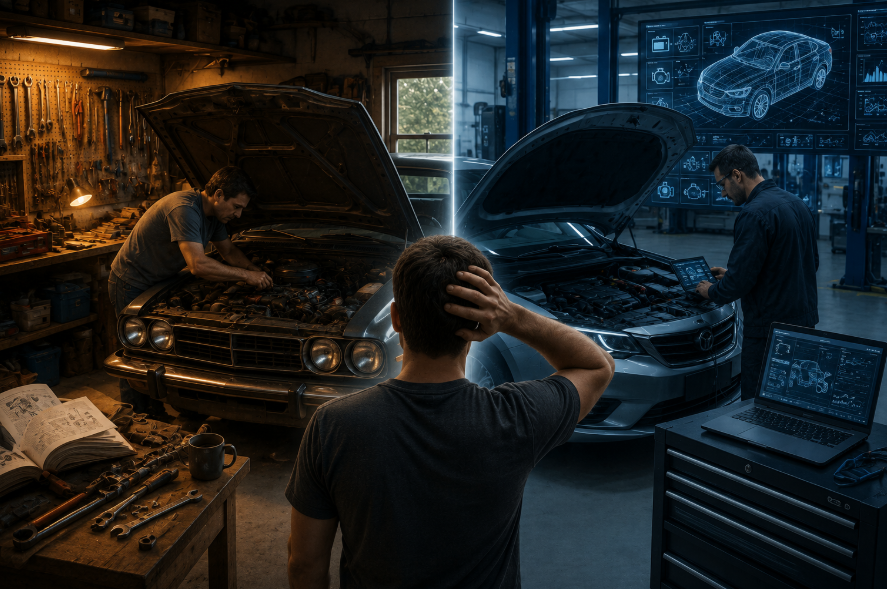
For much of automotive history, working on your own car was seen as a natural part of ownership. Simple mechanical systems, accessible engine bays, and widely available parts meant that basic repairs and maintenance could often be carried out at home with a set of tools and a bit of patience.
Today, that landscape has changed significantly. Modern vehicles are increasingly defined by software, sensors, and integrated electronic systems that make DIY repairs far more difficult than they once were. As a result, car culture itself is shifting — not only in how vehicles are fixed, but in how ownership is experienced.
The decline of home repairs is not simply about convenience. It reflects a deeper transformation in automotive engineering, safety standards, and digital complexity.
From Mechanical Simplicity to Software-Driven Systems
Older vehicles were fundamentally mechanical machines. Engines could be understood in terms of fuel, air, spark, and timing. Many components were physically accessible, and diagnosing issues often involved visual inspection or straightforward mechanical testing.
Modern cars, however, operate as highly integrated electronic systems. Engine control units, sensor networks, advanced driver assistance systems, and infotainment software all interact continuously to manage vehicle performance.
This integration has brought major benefits in efficiency, safety, and emissions control, but it has also created a layer of complexity that is difficult to access without specialised tools.
In many cases, a simple warning light no longer corresponds to a single component fault. Instead, it may reflect a chain of sensor readings and software interpretations that require diagnostic equipment to decode.
The Rise of Proprietary Diagnostics
One of the biggest barriers to DIY repair is the increasing reliance on manufacturer-specific diagnostic systems.
Where earlier generations of vehicles could be diagnosed with generic tools, many modern cars now require proprietary software to access full system data. Even basic fault identification often depends on encrypted communication protocols between the vehicle and diagnostic equipment.
This means that independent repair work increasingly depends on access to manufacturer ecosystems or advanced third-party tools that replicate them.
For enthusiasts, this represents a significant shift. The ability to “read” a car mechanically has been replaced by the need to interpret digital data streams.
Software Updates and Locked Systems
Another major factor contributing to the decline of DIY repairs is the rise of software-controlled functionality.
Many modern vehicles receive over-the-air updates that can alter performance, adjust system behaviour, or fix bugs remotely. While this improves convenience and long-term reliability, it also introduces new layers of control over how vehicles operate.
Some systems are tightly integrated in ways that limit user modification or component replacement. Features may be tied to digital authentication systems or require software calibration after physical repairs.
In certain cases, even replacing a component like a battery or sensor may require system reprogramming to ensure compatibility with the vehicle’s electronic architecture.
This level of integration makes traditional repair approaches increasingly impractical for non-professionals.
Safety Regulations and Manufacturer Control
Safety standards have also played a role in shaping this shift.
Modern vehicles are subject to strict regulatory requirements covering emissions, crash safety, and electronic stability systems. These regulations have encouraged manufacturers to design vehicles with tightly controlled systems that reduce variability in performance and ensure compliance.
While this improves safety outcomes, it also reduces the flexibility that once allowed for simple mechanical intervention.
Manufacturers are understandably cautious about allowing unrestricted modification or repair of systems that are directly linked to safety-critical functions such as braking, steering assistance, or collision detection.
As a result, even well-intentioned DIY repairs can risk unintended consequences if they interfere with integrated safety systems.
Changing Car Culture and Ownership Behaviour
The decline of DIY repair is not just a technical issue — it is also cultural.
In previous decades, working on cars was a central part of enthusiast identity. Enthusiasts often learned mechanical skills through hands-on experience, modifying engines, rebuilding components, or maintaining older vehicles themselves.
Today, that hands-on culture still exists, but it is increasingly concentrated in specialist communities or focused on older vehicles. For many modern car owners, the relationship with their vehicle is more passive, relying on authorised servicing and digital diagnostics rather than personal intervention.
This shift has contributed to a broader change in how people view car ownership. Vehicles are increasingly seen as integrated digital products rather than mechanical projects.
At the same time, automotive personalisation remains important, even if it is expressed differently. Visual identity, configuration choices, and ownership details still play a role in how drivers connect with their vehicles. In this evolving environment, companies like Plates Express sit alongside a wider culture of automotive individuality and presentation.
The Role of Electric Vehicles
Electric vehicles have accelerated the decline of DIY repair even further.
EVs contain fewer moving mechanical parts but far more complex electrical and software systems. High-voltage components, battery management systems, and integrated control software require specialised knowledge and safety precautions.
Unlike traditional internal combustion engines, many EV systems are not designed for user access or modification. Even routine servicing tasks often require certified technicians and manufacturer-approved equipment.
While EVs reduce the frequency of certain types of mechanical maintenance, they increase reliance on professional servicing when issues do occur.
This reinforces the broader trend towards centralised, specialist-led vehicle maintenance.
The Rise of Specialist Independent Workshops
As DIY repairs have declined, independent specialist workshops have become more important within the automotive ecosystem.
These workshops often bridge the gap between manufacturer dealerships and traditional home mechanics. Equipped with advanced diagnostic tools and software access, they are able to perform complex repairs while maintaining more flexibility than official service centres.
For many drivers, this represents a practical compromise — retaining some level of independence from manufacturer networks without attempting repairs that require highly specialised equipment.
What Has Been Lost — and What Has Been Gained
The decline of DIY car repairs is often viewed through a nostalgic lens, but the reality is more nuanced.
On one hand, the loss of accessibility has reduced the hands-on relationship many drivers once had with their vehicles. Mechanical understanding, once common among enthusiasts, is becoming less widespread among everyday motorists.
On the other hand, modern vehicles offer significantly improved safety, reliability, and performance thanks to their electronic systems. Many issues that once required manual intervention are now detected and resolved automatically or through software updates.
The trade-off is clear: greater complexity in exchange for greater capability.
Conclusion
The shift away from DIY car repairs reflects the broader evolution of the automotive industry. As vehicles become more digitally integrated and software-driven, the ability to repair them at home has diminished significantly.
This change is not simply about losing mechanical simplicity, but about the increasing sophistication of modern transport systems. Cars are no longer just mechanical machines — they are interconnected digital platforms that require specialised knowledge and tools to maintain.
While this transformation has altered traditional car culture, it has also created new forms of engagement, from digital diagnostics to software-based personalisation. The nature of vehicle ownership is changing, but the connection between drivers and their cars remains, even if it is expressed in different ways.